
🔔 Read us on Telegram — don’t miss the latest automotive news → t.me/motorhub_en
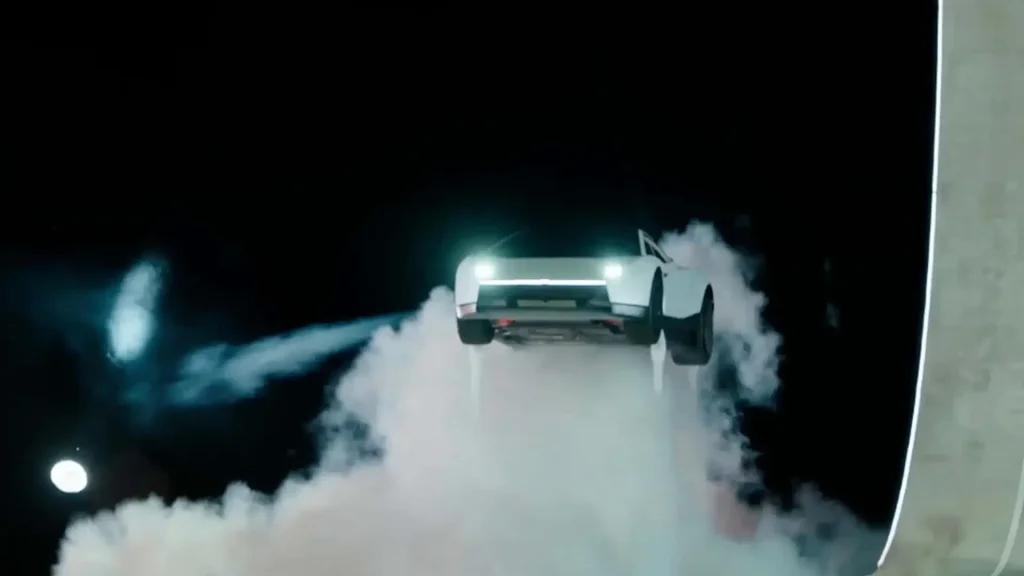
Tesla has officially revealed the second-generation Roadster, a fully redesigned take on the electric supercar first shown in 2017 as a 2020 model. The reveal event in McGregor, Texas, featured a jaw-dropping demonstration: the Roadster drove upside down on a massive ramp using a fan-powered suction system, then launched off the ramp and performed a mid-air barrel roll thanks to cold gas thrusters before landing right-side up. CEO Elon Musk warned beforehand that success was not guaranteed, adding, “It’ll probably work.”
The suction system can generate up to 2Gs of downforce, according to Tesla Vice President of Engineering Lars Moravy, enabling cornering at up to 2G of force — far beyond any production car. The thruster system uses 10 nozzles and 200 liters of compressed gas as propellant. After the upside-down run, the Roadster hopped over a lineup of Tesla vehicles while executing another barrel roll. Musk described the capability as flying like a rocket, capable of “crazy gymnastics.”
Refueling the compressed nitrogen system takes two to six hours, with Tesla hoping to cut that to around thirty minutes. Performance targets are staggering: the 0-60 mph time is claimed to be under one second, with measured times as low as 0.81 seconds, and Musk says the production car will beat that. Top speed tops 230 mph, with an eventual target of roughly half the speed of sound — about 383 mph, given sound travels at 767 mph in air.
The Roadster will launch in three trims. The Performance version includes the suction fan system. The Thrust version delivers the 0.81-second 0-60 time and is described on the retail site as “limited.” The Rocket trim, featuring all 10 thrusters, is “invite only” — meaning most buyers likely won’t get the barrel-rolling version. All three require a refundable $50,000 deposit within ten days of reserving.
Powertrain output reaches up to 1,341 horsepower in the top trim, while the base version’s two motors produce up to 1,073 HP. Despite the high output, all versions are rear-wheel-drive, with one motor per wheel for torque vectoring rather than dual-motor all-wheel-drive. Range is claimed at 310 to 320 miles — a sharp drop from the originally promised 620 miles. Charging supports 500 kW fast charging, enabling a 10-80% charge in just 10 minutes, which Tesla says outpaces any EV currently sold in the United States.
Legality remains a major question mark. Musk acknowledged that using these features may not be legal in all jurisdictions, and the order page confirms the 10-thruster version is not street legal. Whether the rear-facing thrusters could ever be approved is unclear, and the author expresses skepticism about regulatory approval. The Roadster is scheduled for 2028 delivery, though Musk has missed delivery dates many times over the nine years since the original reveal, and the company did not announce pricing or further details at the event. With a $50,000 deposit required, buyers are committing largely blind.
This is the latest chapter in a long, delay-plagued development history. The 2017 reveal promised a 2020 launch with similarly impossible-sounding specs, and after nine years without delivery, much of the benefit of the doubt has evaporated. The Roadster looks otherworldly on paper and in the demo, but the real challenge remains the same: actually delivering it.
📱 Follow our Telegram channel for daily updates
Source: InsideEVs