🔔 Read us on Telegram — don’t miss the latest automotive news → t.me/motorhub_en
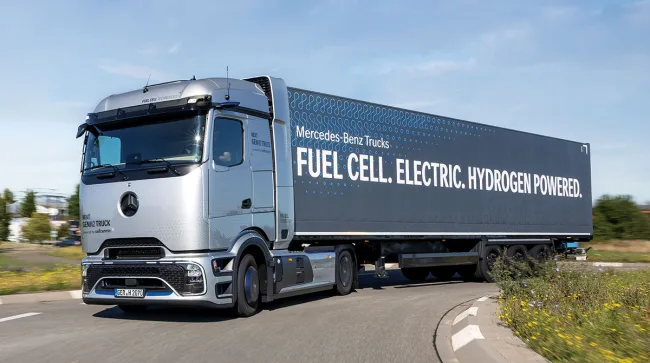
German logistics provider Dachser is set to become the first customer to deploy production models of the Mercedes-Benz NextGenH2 hydrogen fuel cell electric tractor, with the initial rollout planned for December. Daimler Truck confirmed that Dachser will begin using five of these trucks, with three deployed at its Karlsruhe logistics center and two more by mid-2027. These trucks are designed for long-distance freight transport and are based on the Mercedes eActros 600 platform. The NextGenH2 boasts a range exceeding 1,000 kilometers (over 620 miles) on a full fill of liquid hydrogen, with refueling times of approximately 10 to 15 minutes, thanks to Daimler Truck’s sLH2 technology developed with partner Linde. This technology aims to supplement Dachser’s existing fleet of over 190 battery-electric trucks, particularly for applications requiring extended range and rapid refueling. Daimler Truck is pursuing a multi-technology strategy, including battery-electric, diesel, and hydrogen fuel cell electric vehicles. The Wörth plant, near Dachser’s Karlsruhe facility, will produce a total of 100 NextGenH2 trucks by the end of 2026 as part of an initial small series production run. However, Daimler Truck has pushed back its target for series production of these fuel cell trucks to the early 2030s, citing slower-than-anticipated development of hydrogen refueling infrastructure. This marks a delay from previous expectations of series production towards the end of the 2020s. The initial 100 tractors will feature Cellcentric BZA150 fuel cells and the sLH2 technology. Future iterations will incorporate series components from the eActros 600, such as the integrated e-axle and ProCabin. The wheelbase has also been shortened by 150 millimeters to 4,000 mm. Cellcentric, a joint venture involving Daimler Truck, Volvo Group, and Toyota, recently launched an updated fuel cell, the BZA375, designed for improved efficiency and performance, with series production scheduled for the turn of the decade. This new fuel cell offers 20% lower hydrogen consumption and 40% higher power density compared to the BZA150.
📱 Follow our Telegram channel for daily updates
Source: Transport Topics — Michelin & Tires (EN) (ttnews.com)