🔔 Read us on Telegram — don’t miss the latest automotive news → t.me/motorhub_en
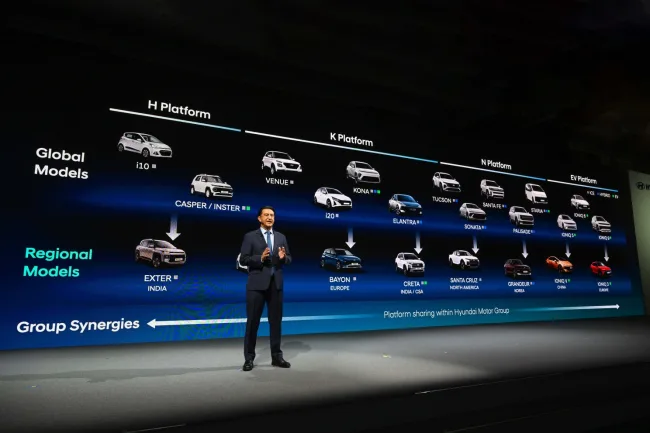
Hyundai Motor Group has launched its most aggressive product offensive to date, announcing plans to introduce more than 100 new or refreshed models globally by 2030. The strategy, unveiled at Hyundai’s CEO Investor Day in Seoul on August 26, 2026, includes 58 models earmarked for the U.S.—Hyundai’s largest market—alongside 41 for Europe, 26 for India, and 22 for China, with some regional overlaps. The expansion spans 18 new segments, including a midsize pickup, light commercial vehicles, and body-on-frame models, as Hyundai seeks to diversify its powertrain lineup beyond pure EVs to include hybrids and extended-range electric vehicles (EREVs).
The push comes as Hyundai targets the booming U.S. hybrid market, where high fuel prices have driven consumer demand toward gas-electric vehicles. The automaker aims to offer more than 10 hybrid models in North America by 2030, with hybrids projected to account for nearly half of regional sales. Seven models are slated to arrive within the next eight months, including an all-new Tucson midsize SUV and its hybrid variant, an all-new Ioniq 3 compact EV, and the first-ever Santa Fe extended-range EV. The Santa Fe EREV targets over 600 miles of total range and features a new battery that charges 40% faster than previous cells; it will be built at Hyundai’s Alabama plant.
Hyundai also confirmed plans to expand global production capacity by nearly 1.3 million units by 2030, including 500,000 units in North America, 320,000 in India, and 200,000 in South Korea. The company intends to increase local parts sourcing in North America to 80% from 60%, a move aimed at mitigating the impact of U.S. auto tariffs while maintaining operating profit margins of at least 9% by 2030. Hyundai’s luxury brand, Genesis, will contribute to the hybrid push with its first hybrid model—the GV80 SUV—set to debut alongside its first extended-range EV early next year, targeting over 640 miles of range. Genesis aims to grow annual sales to 350,000 vehicles by 2030.
The strategy also underscores Hyundai’s focus on robotics and automation. The company’s Robot Metaplant Application Center, which opened at its Georgia facility in June 2026, will expand tenfold by year-end, with over 10,000 hours of robot learning data logged. Production of humanoid robots is scheduled to begin in 2028, with an annual capacity of 30,000 units. Hyundai and affiliate Kia Corp. have previously outlined long-term plans involving autonomous driving and robotics, including Kia’s announcement in April 2026 to introduce eight hybrid models in the U.S. by 2030, deploy humanoid robots in U.S. plants starting in 2029, and deliver its first software-defined vehicle by the end of 2027.
Hyundai’s product offensive reflects a broader recalibration of its manufacturing footprint, particularly at its Georgia plant, which was initially designed for EV production. The automaker is adapting its facilities to pivot between electric, hybrid, and internal combustion variants based on market conditions and trade policies. The announcement follows a 3% drop in Hyundai Motor shares, attributed by analysts to a perceived lack of major updates on robotics innovation despite the recent unveiling of Boston Dynamics’ production-ready Atlas humanoid robot in January 2026.
📱 Follow our Telegram channel for daily updates
Source: Transport Topics — Michelin & Tires (EN) (ttnews.com)