
🔔 Read us on Telegram — don’t miss the latest automotive news → t.me/motorhub_en
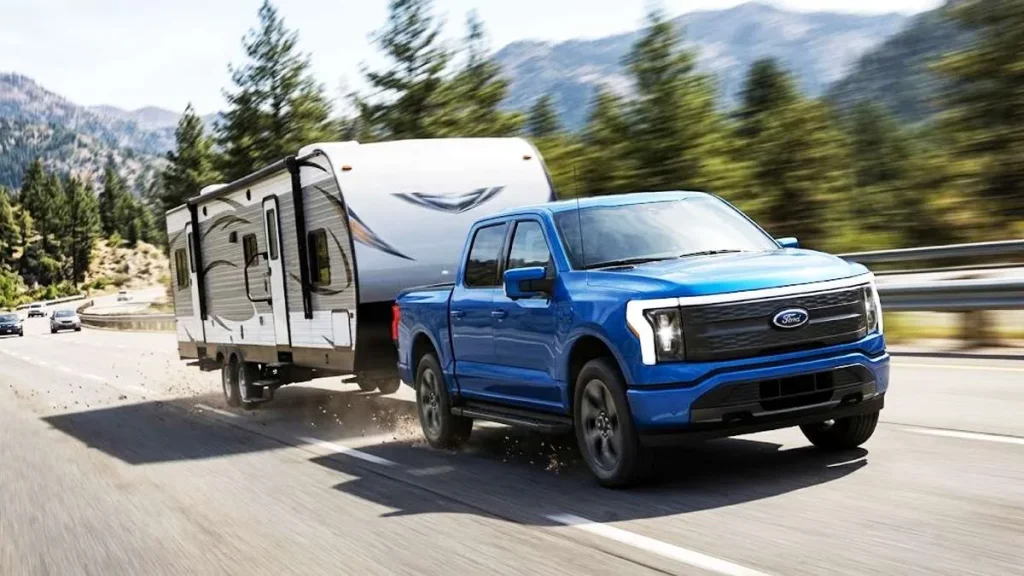
Switching from a heavy-duty diesel truck to an electric half-ton might seem counterintuitive, but one former Ford F-250 Super Duty owner says his Ford F-150 Lightning handles a massive 36-foot RV better than his old workhorse. Rob, who made the switch to a 2025 Ford F-150 Lightning Flash equipped with the Extended-Range battery pack, states he would never go back to diesel after hauling a dual-slide travel trailer weighing nearly 10,000 lbs (roughly 9,800 to 9,900 lbs fully loaded). Traditionalists often fear trailer sway when swapping a 3/4-ton diesel for an EV half-ton, but the Lightning’s flat-mounted battery pack creates an ultra-low center of gravity. This acts as a built-in anti-sway anchor, keeping the rig remarkably planted against severe crosswinds or passing 18-wheelers. The channel’s host noted that the electric truck feels smoother and tows like an F-250 or better. However, towing near the Max Tow Package limit of 10,000 lbs requires careful attention to payload capacity, as a 10,000-lb trailer puts 1,000 lbs or more of tongue weight on the hitch, making a weight-distribution hitch essential to avoid exceeding Gross Axle Weight Ratings. The trip also delivered a major physics lesson: frontal area drag kills EV range far more than trailer weight. During a father-son road trip to Gettysburg, Pennsylvania, the host tracked efficiency while towing a 36-foot Cherokee Grey Wolf 29TE travel trailer weighing 7,500 lbs on Toyo Open Country AT3 EV tires, averaging 0.9 miles per kilowatt-hour in high winds. Meanwhile, Rob averaged 0.8 mi/kWh with his heavier, dual-slide trailer of the exact same 36-foot length. The difference came down to height: Rob’s camper sat one foot taller, pushing an extra square foot of front wall through the air and creating significantly more aerodynamic drag. In the mountain regen debate, experienced EV drivers on Reddit highlighted that using Ford’s One-Pedal Drive mode lets the electric motors handle deceleration first to capture energy back into the battery, saving brake pads compared to traditional mechanical trailer brakes. On the infrastructure side, drivers utilized pull-through charging bays at locations such as GM Energy Pilot/Flying J, ChargePoint stalls at Love’s, and select Tesla locations without uncoupling their trailers. Campgrounds also provided an overnight charging hack by plugging trucks into standard 30-amp and 50-amp RV hookups, allowing drivers to wake up with a full battery for zero extra fuel cost, though calling ahead to check campground EV policies is recommended. Finally, addressing range anxiety, the host argued that automakers do not need massive 200 kWh battery packs, but rather faster charging curves that can handle a 20% to 80% charge in 15 or 20 minutes.
📱 Follow our Telegram channel for daily updates
Source: Torque News