
🔔 Read us on Telegram — don’t miss the latest automotive news → t.me/motorhub_en
The three-year SPIRIT-E research project concluded with clear results on October 30, 2026, demonstrating that electric trucks can act as active energy storage systems. Led by the Technical University of Munich (TUM) alongside eight project partners—including MAN Truck & Bus, Consolinno Energy, Fraunhofer IEE, Hubject, Forschungsstelle für Energiewirtschaft (FfE), TenneT, and SBRS—the project successfully tested bidirectional charging in a real-world laboratory at the Schmid transport company in Regensburg. Funded by the Federal Ministry for Economic Affairs and Energy (BMWE) and supervised by the DLR Project Management Agency, the project ran from August 2023 to October 2026.
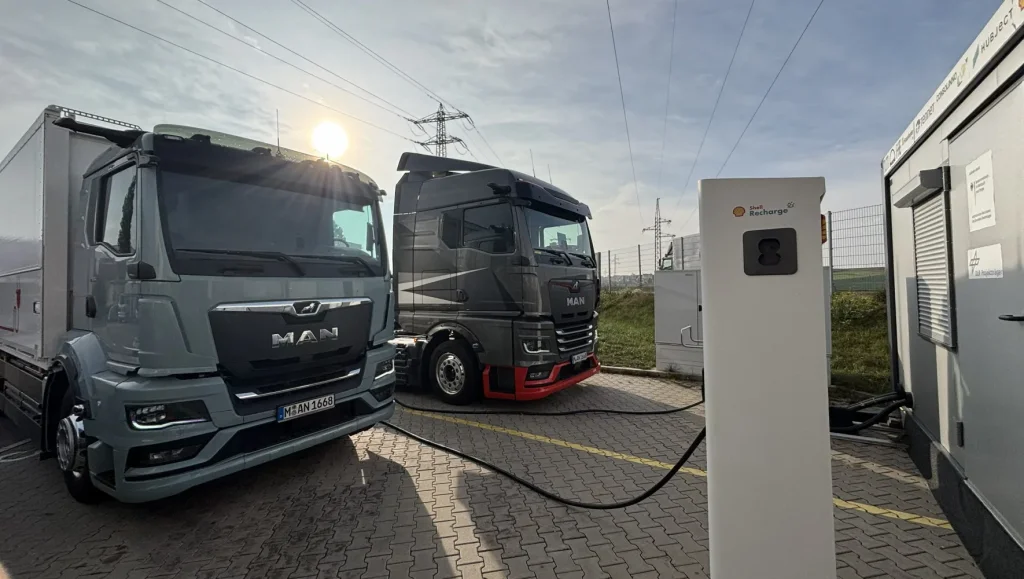
During testing, a MAN eTGX featuring 480 kWh of usable energy successfully fed up to 350 kW of power back into the local site grid (Vehicle-to-Site / V2S) and the public electricity grid (Vehicle-to-Grid / V2G) using a bidirectional DC charging station from SBRS. Vehicle-to-Vehicle (V2V) charging—supplying other vehicles directly from the truck battery—was also successfully demonstrated. The technical foundation relies on the implementation of ISO 15118-20, the international communication standard between vehicles and charging infrastructure.
Project testing also explored electricity trading and grid stabilization. Using a test environment from software provider PowerBot, the eTruck simulated buying cheap electricity and selling it when prices were high. Furthermore, testing via the European EQUIGY platform demonstrated how electric trucks can assist grid operators in balancing electricity grid bottlenecks.
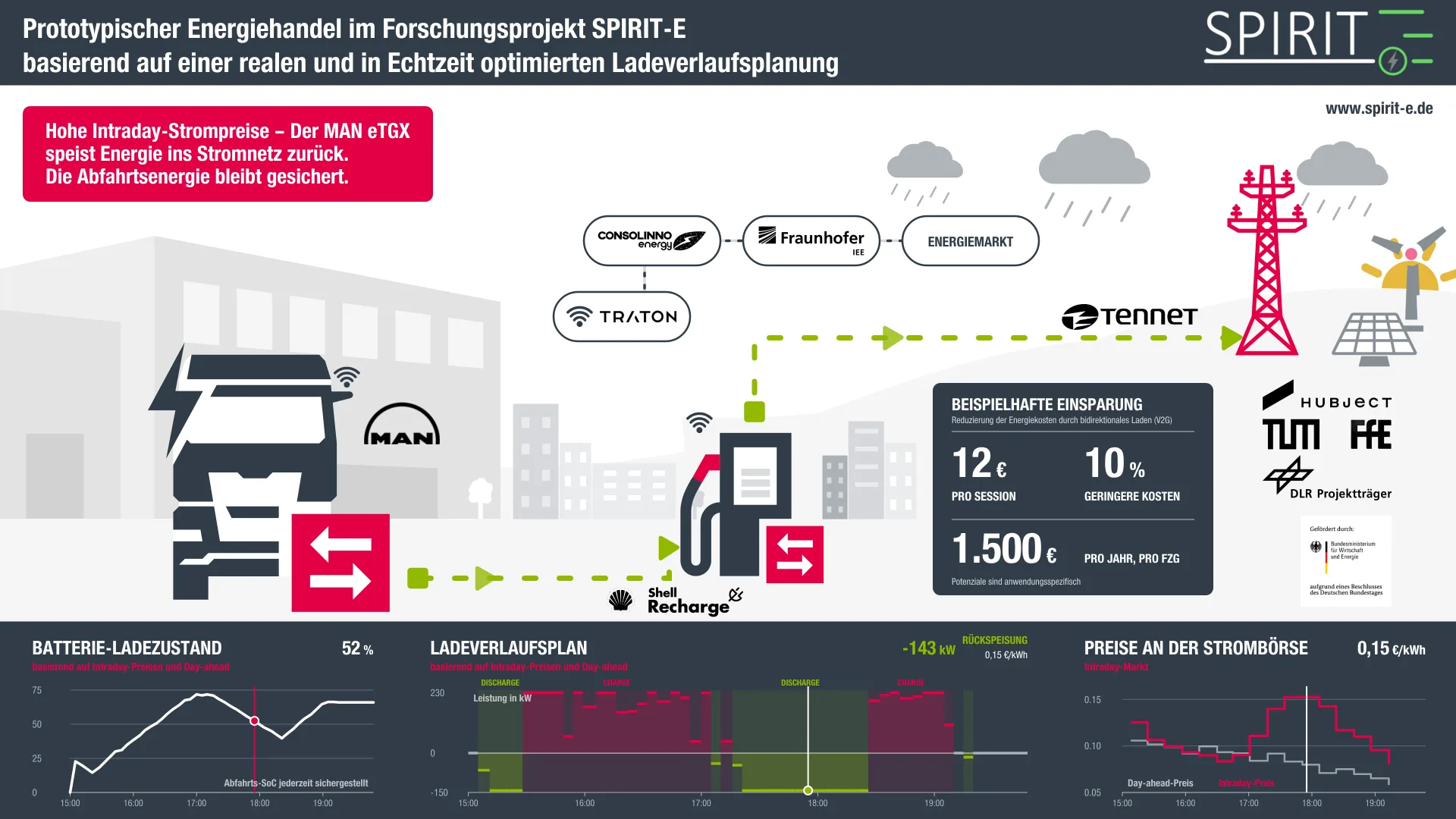
While technical feasibility has been proven, project findings emphasize that profitability is not guaranteed and depends on individual operational factors. These include duty cycles, annual mileage, depot downtime, battery size, electricity prices, grid fees, local solar (photovoltaic) generation, and available grid connection capacity. Bidirectional charging is most attractive for electric trucks with regular depot downtimes and less than 100,000 km of annual mileage. V2S and V2V applications achieve average energy cost savings of around 10 percent, with optimal conditions yielding up to 20 percent.
MAN Truck & Bus announced plans to bring the bidirectional feature to production for the MAN eTGX and is developing consulting concepts to help fleet operators utilize the technology. For broader market rollout, the project highlights the need for simplified standards for flexible power trading, digital integration of the logistics and energy sectors, and increased know-how among fleet operators.
📱 Follow our Telegram channel for daily updates
Source: MAN Truck & Bus