
🔔 Read us on Telegram — don’t miss the latest automotive news → t.me/motorhub_en
Before factory-fit air conditioning became the norm, early motorists had to improvise to stay cool behind the wheel. The first cars were open-top contraptions like the Ford Model T roadster and touring models, which lacked even a driver’s door. Drivers draped umbrellas over their heads to block the sun and bundled up in heavy driving gear—think caps, duster coats, goatskin gloves, and leather storm coats—regardless of the weather.
The turning point came in 1905 when Cadillac debuted the Osceola prototype, the first enclosed-body car. By the 1920s, nearly every automaker had switched to closed cabins, but that created a new problem: stifling heat. Carmakers responded with roll-down windows and under-dashboard vents, though these openings also let in dust, dirt, insects, and pollen.
In 1919, the Kool Kooshion auto seat cover hit the market, featuring half-inch springs to lift the driver’s body off the seat and promote airflow to evaporate sweat. Still, seat covers couldn’t cool an entire cabin. In 1921, the Knapp Limo-Sedan Fan arrived—a small electric fan that could be installed in vintage cars to stir the air, though it only made the cabin breezier, not cooler.
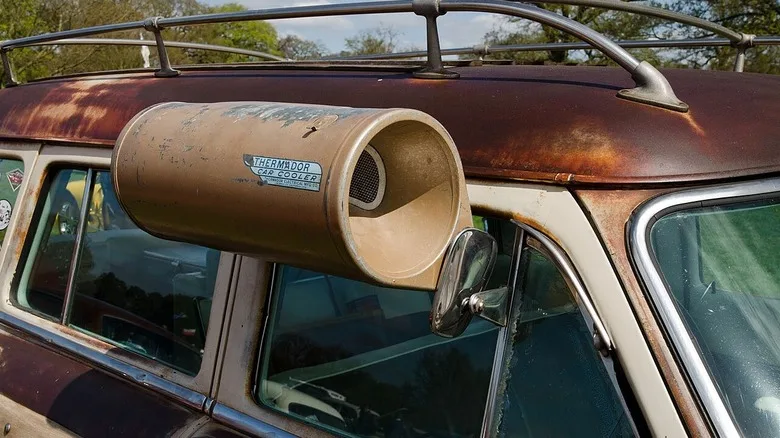
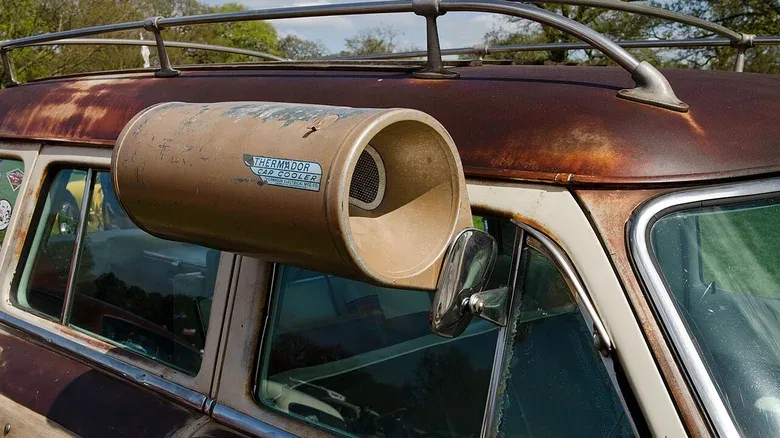
A more ambitious solution came around the 1930s with the “car cooler,” a missile-shaped metal box mounted above the window. It held a one-and-a-half-gallon water reservoir and a water-saturated pad; as the car moved, air passed through the pad, cooled via evaporation, and was routed into the cabin. The device could drop interior temps by 15 to 20 degrees Fahrenheit, but only while driving and only in dry conditions.
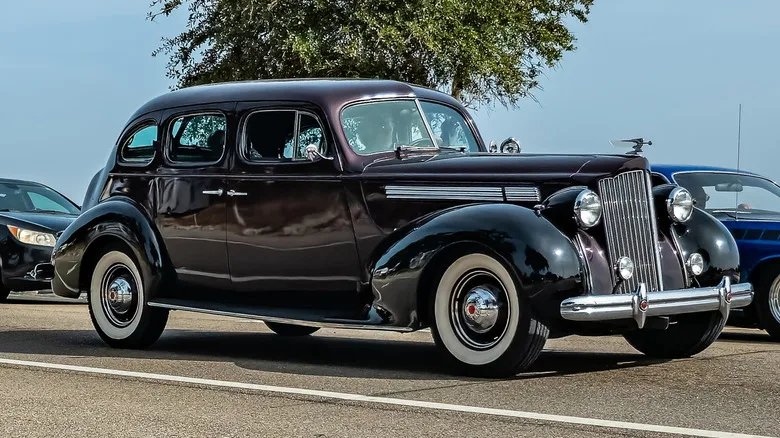
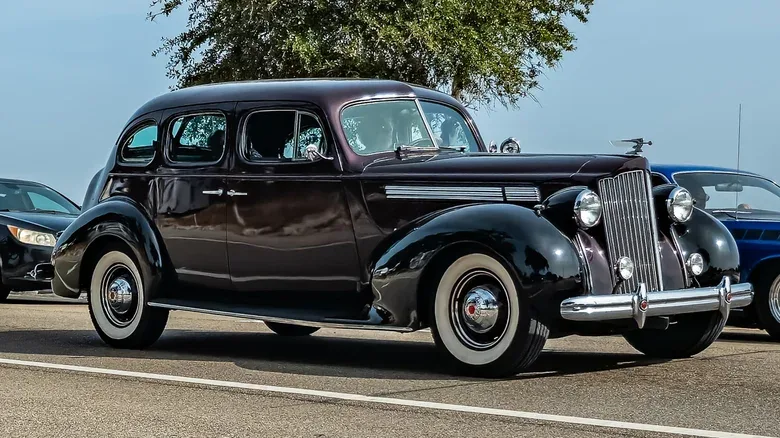
In humid weather or at low speeds, its cooling power vanished, and the half-gallon tank needed refilling every three hours in extreme heat. The breakthrough finally arrived when General Motors and Packard pioneered automotive air conditioning. In 1939, Packard became the first automaker to offer optional A/C, though it was a trunk-mounted system that cost $274 (about $5,000 today).

The unit was so large it took up half the trunk, required manually removing the drive belt to turn it on or off, and offered no temperature controls. Pontiac and Nash moved the A/C hardware to the front in 1954, integrating it with the heater under the dashboard. Cadillac then introduced Comfort Control in 1964, the first automatic climate control system.
By 1969, the AMC Ambassador became the first production car to leave the factory with standard A/C, marking the end of the improvisational era and the beginning of factory-cooled comfort.
📱 Follow our Telegram channel for daily updates
Source: Jalopnik (Auto Culture & Tuning) (jalopnik.com)