🔔 Read us on Telegram — don’t miss the latest automotive news → t.me/motorhub_en
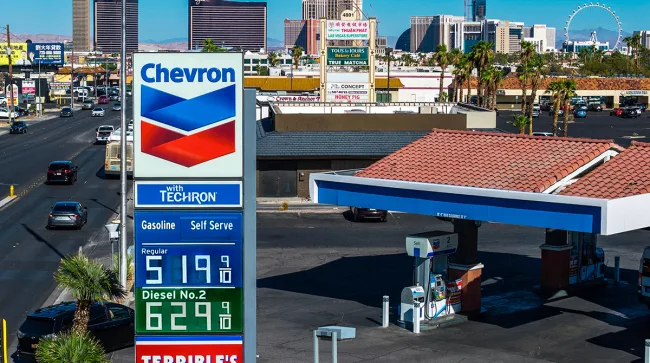
Government Business Safety Fuel Logistics Oil prices hit highest level in 6 weeks on war flare-ups Brent crude rises 1.5% to $98.48 a barrel Elaine Kurtenbach and Matt Ott | Associated Press September 8, 2026 8:18 AM, EDT Chevron gas station prices are displayed in Las Vegas on Sept. 3. (L.E. Baskow/Las Vegas Review-Journal via AP) Key Takeaways: The broadening Middle East conflict pushed oil prices higher. A wave of Houthi attacks on oil facilities and utilities in Saudi Arabia’s southern region has escalated renewed fighting between an important U.S. ally and Iranian-backed rebels in Yemen. Elevated oil prices have raised costs for consumers and businesses alike and gives this week’s inflation data from the government even more weight than usual. [Stay on top of transportation news: Get TTNews in your inbox.] U.S. stock futures were mixed early Sept. 8 as flare-ups in the broadening Middle East conflict pushed oil prices higher. Futures for the S&P 500 fell 0.3% before the bell, while futures for the Dow Jones Industrial Average slid 0.8%. Nasdaq futures were unchanged. A wave of Houthi attacks on oil facilities and utilities in Saudi Arabia’s southern region has escalated renewed fighting between an important U.S. ally and Iranian-backed rebels in Yemen. In energy markets, Brent crude, the international standard, added 1.5% to $98.48 a barrel — its highest level in about six weeks — as tensions simmered in the six-month U.S. war with Iran. Benchmark U.S. crude surged 2.5% to $93.79 a barrel, about 40% than it was in late February just before the U.S. and Israel launched their attacks on Iran. Elevated oil prices have raised costs for consumers and businesses alike and gives this week’s inflation data from the government even more weight than usual. The Federal Reserve meets next week to decide whether to cut, raise or hold interest rates. That decision has been made more complicated by a fairly sturdy job market and a historically low employment rate. this is the time of year that most Americans see gas prices going down as demand falls and we soon change to winter gasoline, but as of late, we’ve been seeing a lot more ups- especially for diesel- the fuel that drives the U.S. economy and that may continue… pic.twitter.com/pGEkq6rkeW — Patrick De Haan (@GasBuddyGuy) September 8, 2026 On Sept. 10, the U.S. government will release its August report for inflation at the wholesale level, called the Producer Price Index, or PPI. It provides data on prices for businesses before they pass along the costs to consumers. The more closely watched Consumer Price Index comes out on Sept. 11. The CPI provides details on price changes for specific grocery items, furniture, and clothing, among other categories. In Asia, Tokyo’s Nikkei 225 gave up early gains, sinking 1.7% to 65,269.33 as major exporters were sold due to a surge in the value of the Japanese yen. Shares in Toyota Motor Corp. shed 4.1%, while electronics maker Panasonic Holdings Corp. fell 5.8%. Early Sept. 8, the U.S. dollar edged down to 154.25 Japanese yen from 154.34 yen. The yen has gained value against the dollar in the past few days on expectations that the U.S. and Japanese governments might intervene to prevent the yen from weakening further. Last week, the dollar briefly rose to about 160 yen. The government reported that the economy grew at a slightly faster annual pace in the April-June quarter than earlier reported, at 1.4%. Earlier, the Cabinet Office had estimated the annualized growth rate at 1.1%. The revision reflects stronger business investment than earlier reported, though overall investment still contracted, at minus 0.9%, Norihiro Yamaguchi of Oxford Economics said in a commentary. “The boost to consumption from policy measures seen in April-May is already fading, and supply-side-driven inflation will accelerate ahead as firms will pass on increased costs, deteriorating consumers’ purchasing power,” he said. South Korea’s Kospi fell back after an early rally, losing 0.6% to 6,954.52. Shares in Samsung Electronics handed back early gains to slip 0.2%. Hong Kong’s Hang Seng lost 0.4% to 25,317.18, and the Shanghai Composite index edged 0.2% higher, to 3,940.55. China said its exports jumped 25% year-on-year in August, driven by strong demand for autos and high tech items. AP Business Writers Chan Ho-him in Bangkok and Yuri Kageyama in Tokyo contributed to this report. More Content About: oil prices, Iran, crude oil, Strait of Hormuz Related Articles US and Iran Eye Ceasefire Extension Amid Hormuz Standoff U.S. commander declares Hormuz shipping lanes are mine-free Oil prices decline as U.S. raises pressure on Iran
📱 Follow our Telegram channel for daily updates
Source: Transport Topics — Michelin & Tires (EN) (ttnews.com)