
🔔 Read us on Telegram — don’t miss the latest automotive news → t.me/motorhub_en
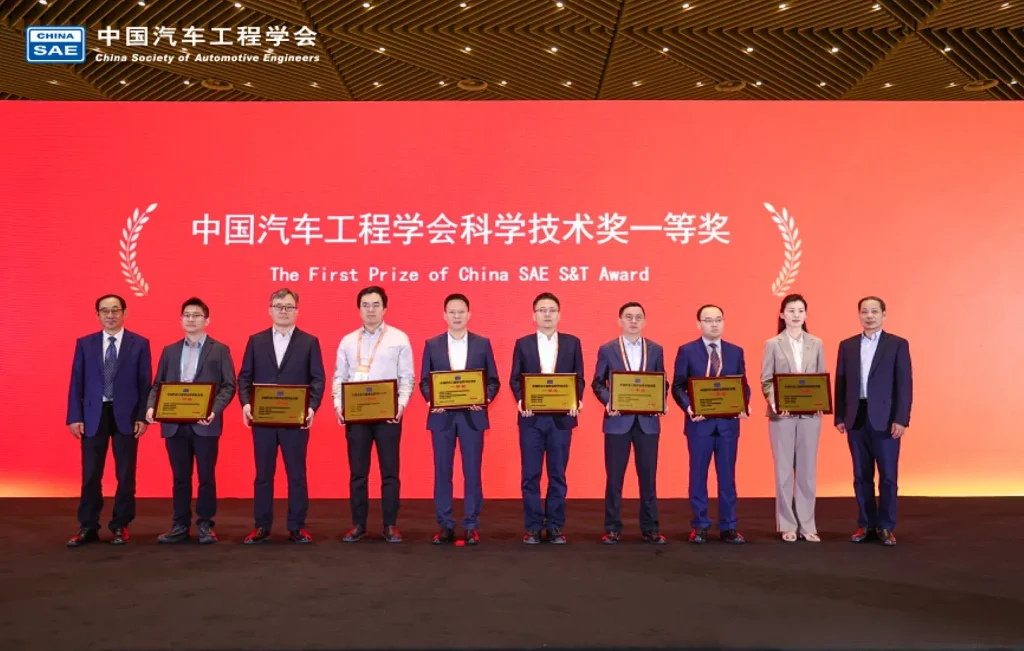
EV GAC’s 99.03% efficient Quark 2.0 drive takes first prize in China’s 2026 engineering awards 3 min to read Nov 3, 2026 7:34 AM CET Component breakdown of the Quark 2.0 motor: the 1 mm carbon-fibre rotor sleeve (left) pairs with a 0.025 mm amorphous alloy ribbon stator to hit a certified 99.03% peak efficiency. Credit: GAC Understand China EV’s Market Real-time notifications when critical EV data is released All important data in one place 2,000,000+ data points Become a member GAC Group has disclosed further technical and manufacturing details of its Quark Electric Drive 2.0 after the technology won First Prize at the 2026 China Society of Automotive Engineers (China-SAE) Science and Technology Awards in Suzhou on October 28. The system combines an amorphous alloy stator with a carbon-fibre rotor sleeve, achieving CAERI-certified peak motor efficiency of 99.03% and 94.184% efficiency under comprehensive CLTC operating conditions. The award recognised the project Key Technologies and Applications of High-Efficiency and High-Power-Density Amorphous-Carbon Fibre Electric Drives for New Energy Vehicles, developed by GAC and nine other organisations. The recognition came alongside Nio’s 925V continuous-wave winding system, which also received First Prize. According to testing certified by the China Automotive Engineering Research Institute (CAERI), Quark 2.0 achieves 99.03% peak motor efficiency. Its 12-in-1 integrated electric drive assembly records 94.184% efficiency under CLTC operating conditions, while power density reaches 17.29 kW/kg. The motor supports rotational speeds of up to 30,000 rpm. The figures build on GAC’s earlier production milestone in August 2024, when its powertrain subsidiary RuiPai Powertrain reported 98.5% efficiency and 13 kW/kg power density. The latest disclosures add certified efficiency results and manufacturing details. Amorphous alloy stator uses 25-micron ribbons Quark 2.0 replaces conventional silicon-steel stator laminations with amorphous soft-magnetic alloy ribbons measuring 0.025 mm (25 microns) thick. Their non-crystalline atomic structure helps reduce magnetic losses, particularly at high operating frequencies. GAC reports stator core iron loss of 5.7 W/kg, approximately 50% lower than ultra-thin silicon steel, alongside a saturation magnetic induction of 1.68 T. Processing the brittle ribbons into automotive-grade stator cores requires specialised manufacturing equipment. GAC developed automated composite processing, stamping and stacking systems capable of handling ribbons wider than 240 mm. Award recipients holding plaques on stage at the 2026 China-SAE Science and Technology Awards ceremony in Suzhou. Credit: China-SAE Carbon-fibre rotor sleeve supports 30,000 rpm The rotor uses a 1 mm carbon-fibre composite sleeve to contain centrifugal forces at speeds of up to 30,000 rpm. Compared with a thicker metallic retention sleeve, the thinner construction reduces rotor mass and allows a smaller magnetic air gap. GAC disclosed several manufacturing measures to address bonding, thermal resistance and exposure to cooling fluids. Plasma surface activation of the metallic rotor core increases interfacial bonding strength by more than 40%, helping prevent separation between the metal and carbon-fibre components. The composite uses a specially formulated resin rated for temperatures of 180°C and tensile strength above 90 MPa. Designed for oil-cooled motor applications involving automatic transmission fluid (ATF), the resin maintains an oil-immersion swelling rate below 1.5%. Automated winding also keeps carbon-filament tension variation within ±5% across successive layers, helping maintain consistent mechanical loading around the rotor. RuiPai targets 100,000-unit annual production capacity GAC subsidiary RuiPai Powertrain Technology manufactures Quark 2.0 in Guangzhou, where an automated production line has an annual capacity of 100,000 units. GAC says the amorphous alloy and carbon-fibre electric drive technology has entered batch production across Hyptec and Aion models, including the 2027 Aion i60. According to GAC, the drivetrain can reduce vehicle energy consumption by approximately 4% and add 30 to 50 km of CLTC driving range without increasing battery capacity. This corresponds to approximately 25 to 42 km under an indicative WLTP conversion, although actual gains depend on vehicle configuration and operating conditions. The latest disclosures provide a clearer picture of how GAC is translating its high-speed motor technology into volume production, following the initial production milestone in 2024. Everyone’s a China auto expert lately. Trusted by industry professionals for 16 years. See the information you trust first: Add CarNewsChina as a preferred source on Google. Add as preferred source Aion GAC Recommended for you GAC Aion’s “half-priced Xiaomi SU7” Ray 7 set for November 12 launch GAC’s battery arm Inpow launches production at new Thailand facility GAC to replace FAW in the FAW Toyota joint venture to streamline operations Most important news in your inbox. Recaps · scheduled All you need, in one email. Instant alerts · real-time Ping me when an article goes live. 0 of 27 topics selected Bundle into one email per day — instead of one email per article Follow us for EV updates Join our Telegram Follow us on Google News Comments
📱 Follow our Telegram channel for daily updates
Source: Car News China