
🔔 Read us on Telegram — don’t miss the latest automotive news → t.me/motorhub_en
In 1989, Dodge struck a deal with Cummins to shoehorn a heavy-duty industrial engine into its light-duty Ram trucks. The engine in question was the 5.9-liter inline-six turbo diesel, known internally as the 6BT. Originally designed for farm equipment, marine use, and commercial machinery, the 6BT was a rugged beast with a cast-iron block, cylinder head, and seven main bearings—overbuilt for a pickup truck from day one.
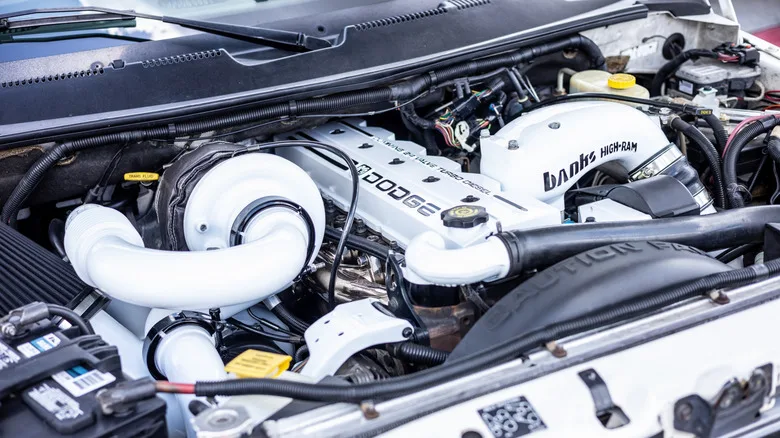
When it debuted under the Ram’s hood, it made just 160 horsepower and 400 pound-feet of torque, but its structural integrity was off the charts. Many 5.9L Cummins engines have since eclipsed 200,000 miles with minimal fuss, thanks to components like a forged steel crankshaft, thick connecting rods, and cast aluminum pistons that barely flinched under the modest stock output. The real magic, however, was in the tuning.
The 6BT’s Bosch P7100 mechanical fuel injection pump—dubbed the “P-pump”—was a grease-monkey’s dream. Zero electronics, no laptops, no software licenses required. Enthusiasts discovered they could yank the factory fuel plate, stuff in a set of 4,000 rpm governor springs, and bolt on oversized injectors (5×0.016) to unleash serious power.

Swap in a BorgWarner S364.5 turbo, and suddenly you had a driveway-built monster capable of pushing 700 horsepower without touching the bottom end. This mechanical simplicity birthed a tuning subculture where trucks could be built in a driveway, leading to legendary “P-Pumped” drift rigs that could humble lowered Volvos or JDM missiles. By 1998, emissions regulations forced Cummins to ditch the purely mechanical route.

The 5.9L 6BT evolved into the 24-valve ISB5.9, introducing electronic fuel injection and a four-valve-per-cylinder head for better airflow. The game-changer arrived in 2003 with the switch to a high-pressure common rail system, where fuel pressures hit 160 MPa (23,000 PSI) and tuning shifted from wrenches to keyboards. Platforms like EFILive let tuners dial in timing, duration, fuel rail pressure, and more, pushing trucks from docile daily drivers to weekend 1,000-horsepower beasts.
The 5.9L’s legacy lived on when it grew into the 6.7 Cummins in mid-2007, gaining a 13% displacement bump, common rail pressures up to 180 MPa (26,000 PSI), and factory torque figures hitting 650 pound-feet. Yet it was the 5.9L’s unkillable industrial block and shockingly mod-friendly fuel system—first with hand tools, then with laptops—that accidentally turned the Dodge Ram from a blue-collar hauler into a performance icon. The 5.9 Cummins Ram isn’t just a truck; it’s a tuning legend.
📱 Follow our Telegram channel for daily updates
Source: Jalopnik (Auto Culture & Tuning) (jalopnik.com)