🔔 Read us on Telegram — don’t miss the latest automotive news → t.me/motorhub_en
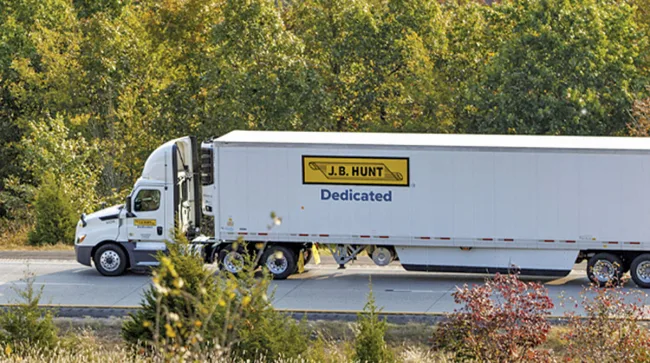
J.B. Hunt Transport Services expects a significant tailwind for its dedicated trucking operations following the U.S. Supreme Court’s Montgomery v. Caribe Transport II ruling, which broadens liability risks for freight brokers and could tighten capacity across the sector. Speaking at the Wells Fargo Industrials & Materials Conference on June 9, Executive Vice President of Sales and Marketing Spencer Frazier highlighted how the decision aligns with the company’s push to replace private fleets with dedicated contract carriage—a model prized by shippers for stability amid volatile spot-market conditions. Frazier emphasized that J.B. Hunt’s rigorous carrier-vetting standards, which exclude conditional carriers and require at least one year of service before tendering loads, position it as a lower-risk partner in a market increasingly focused on safety and risk mitigation. The company ranks No. 3 among North America’s largest for-hire carriers on the Transport Topics Top 100 list, No. 2 in the truckload/dedicated segment, and No. 1 in intermodal/drayage. Senior Vice President of Intermodal Operations Bill Dietrich underscored the company’s disciplined approach, noting that J.B. Hunt does not use conditional carriers and maintains a minimum one-year service requirement for carriers before engaging them. The Montgomery ruling, which allows a truck driver injured by a negligent carrier to sue the broker that hired them, is expected to push shippers toward safer, more reliable carriers—an area where J.B. Hunt’s safety record and operational discipline give it a competitive edge. Frazier noted that the company’s dedicated fleet has delivered double-digit returns for over a decade, with a pipeline targeting the addition of 800 to 1,000 trucks in 2026. The ruling arrives as dedicated contract carriage gains momentum, with shippers prioritizing stability over the volatility of the spot truckload market. Frazier also pointed out that private fleets often lack the resources to match J.B. Hunt’s safety standards and equipment investments, making dedicated carriers a more attractive alternative. The regulatory environment is further tightening capacity, with observers warning the Montgomery decision could increase insurance costs for brokers and deter high-risk carriers from operating. Meanwhile, competitors like Werner Enterprises are also expanding their dedicated units, with CFO Chris Wikoff acknowledging gradual rate strength in dedicated contract renewals. Werner’s January acquisition of FirstFleet for $282.8 million positioned it as the fifth-largest dedicated carrier in the U.S. by power units, boosting its dedicated revenue by approximately 50%. Schneider, another top-20 for-hire carrier, has also signaled growing enthusiasm for dedicated fleet growth, with its dedicated fleet approaching 8,600 tractors. J.B. Hunt’s dedicated operations are already a cornerstone of its growth strategy, with Frazier describing the portfolio as stronger than ever and its pipeline as significant. The company’s ability to attract shippers seeking to offload the complexities of private fleet management—including safety compliance and equipment investment—further solidifies its leadership in the dedicated segment.
📱 Follow our Telegram channel for daily updates
Source: Transport Topics — Michelin & Tires (EN) (ttnews.com)