
🔔 Read us on Telegram — don’t miss the latest automotive news → t.me/motorhub_en
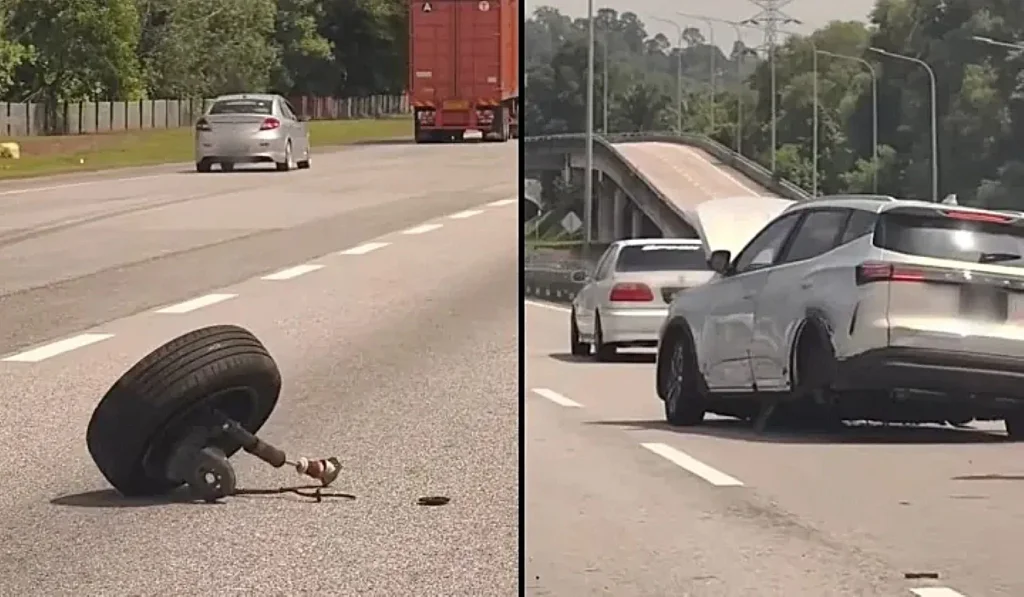
A Chery Tiggo Cross was involved in a collision with a Perodua Myvi on Malaysia’s New Klang Valley Expressway (NKVE) on November 7, 2026. The impact left the SUV stranded on the tarmac with two wheels detached from the vehicle. Chery Auto Malaysia confirmed the incident and stated that the wheel separation and front‑bumper damage were caused by the accident, not by a defect in the vehicle’s components. The company’s spokesperson, Paul Tan, urged the public not to circulate unverified information and said the team had already contacted the customer to offer assistance. No detailed technical assessment of the vehicle was released.
Footage that circulated online showed both damaged vehicles on the expressway, with the Chery SUV’s wheels visibly separated. The images documented the aftermath but did not establish the exact collision sequence or the precise moment the wheels detached.
This incident follows another wheel‑related headline in Southeast Asia. On November 4, a Jaecoo J5 EV in Central Jakarta, Indonesia, lost its front‑right wheel after striking a roadside curb and barrier. Jaecoo Indonesia attributed the separation to the impact, citing a technical inspection that ruled out a product defect.
The Tiggo Cross collision also comes after regulatory action involving the Omoda 5 in Malaysia. In October, the country’s Road Transport Department (JPJ) temporarily suspended Vehicle Type Approval (VTA) for the pre‑facelift petrol model, preventing new registrations under that approval pending an investigation and safety assessment. Chery subsequently announced an inspection and replacement campaign covering 8,878 Omoda 5 C and H vehicles.
Separately, China’s State Administration for Market Regulation (SAMR) announced a recall on November 6 that covers 53,882 Chery Tiggo 5x and Omoda‑series vehicles manufactured between June 6, 2022 and December 31, 2023. The recall concerns potentially insufficient welding at the connection between the rear‑axle trailing arm and its sleeve. Under extreme conditions, the joint could fail and compromise rear‑wheel control. The recall takes effect on November 27, 2026. Chery will inspect the affected production batches and replace rear axles identified as belonging to the defective batch free of charge. Not all 53,882 vehicles have been confirmed to contain the affected components.
The Malaysian and Chinese campaigns address rear‑axle manufacturing issues, unlike the collision‑related wheel separations reported in Indonesia and Malaysia. The available information does not establish a common technical cause between these incidents. The Omoda 5 failures also prompted Chery Chairman Yin Tongyue to apologise to Malaysian authorities.
For Chery, the latest collision adds to an increasingly crowded sequence of regional vehicle‑quality headlines, even though the Tiggo Cross incident has not been independently linked to the Omoda 5’s manufacturing defect. The company remains focused on addressing the recall and supporting affected customers while clarifying that the wheel loss in the Malaysia crash was a result of the collision, not a design flaw.
📱 Follow our Telegram channel for daily updates
Source: Car News China