
🔔 Read us on Telegram — don’t miss the latest automotive news → t.me/motorhub_en
One owner used his Volkswagen Dieselgate payout to buy a 2017 Chevy Bolt that has now surpassed 185,000 miles (298,000 km), while another owner liked his Bolt enough to buy a second one for his wife. This enduring brand loyalty serves as the backdrop for the new 2027 Chevy Bolt RS, which was tested over 300 miles of city and highway driving around Charlotte, North Carolina. The updated model preserves the practical and affordable formula loved by owners while fixing the original car’s primary weakness with DC fast charging up to 150 kW, a native NACS port, an EPA-estimated 262 miles of range, and an estimated annual electricity cost of $750. The test car was priced at $38,940.
Chevrolet Bolt owners form a loyal community. Guylain, a former VW diesel owner compensated after the Dieselgate scandal, stated that the payout made the switch to an EV worthwhile for his 2017 Bolt. Another owner, Dorrington, drove a 2016 Chevy Spark EV from 2019 to 2023, sold it to Carvana, and bought a local 2020 Bolt Premier, later adding a 2021 Premier for his wife. Despite past challenges, including a massive recall for battery replacements across all Bolt EV and EUV models built, many owners remain dedicated, with some calling their purchase one of the best they have ever made.
The 2027 Bolt brings substantial upgrades beneath the floor and at the charging port. It features a 65 kWh lithium iron phosphate (LFP) battery, delivering 210 horsepower and 169 lb-ft of torque via front-wheel drive. The EPA range is 262 miles, with a combined efficiency of 120 MPGe (134 city, 106 highway). DC fast charging reaches up to 150 kW, taking about 25 minutes from 10% to 80% according to Chevrolet. Home charging runs at 11.5 kW, taking approximately 6.8 hours on 240 volts based on the window sticker. The charge port is a native NACS design, and the estimated annual electricity cost is $750, with projected fuel savings of $4,250 over five years compared to the average new vehicle. The LT trim starts at $27,600 before destination, while the tested RS model starts at $31,600 before destination, totaling $38,940 as tested.
The jump to 150 kW fast charging addresses the slow charging speeds of the original model, which was its biggest drawback on road trips. The native NACS port also provides direct access to Tesla Superchargers without requiring an adapter.
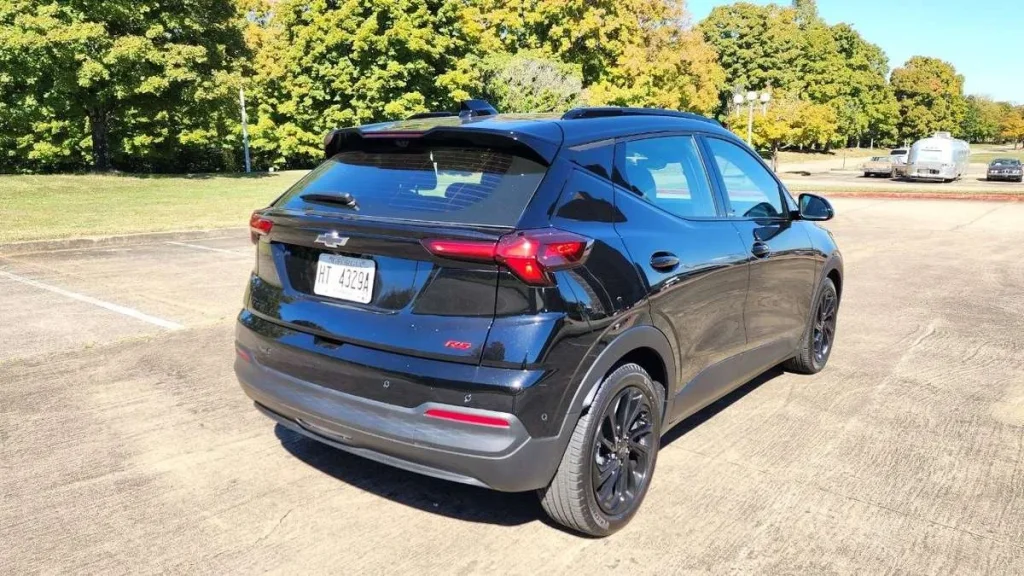
Externally, the Bolt maintains its compact, practical hatchback proportions while adopting sharper, more modern styling with slim lighting and a cleaner front fascia. The Mosaic Black Metallic paint on the test vehicle paired well with the RS trim’s dark accents. Its compact dimensions make it easy to park, maneuver in tight spaces, and handle heavy traffic in Charlotte.
The RS is positioned as the sportier-looking trim, adding gloss-black exterior styling elements, black wheels, RS badging, red interior stitching, and ambient lighting. The test car’s window sticker specified 17-inch gloss-black wheels, gloss-black roof rails, bi-color ambient interior lighting, and a Jet Black interior with red accents. Additional reported features include heated and ventilated front seats. While Autoblog notes that the RS changes are mostly cosmetic and many features can be optioned on the LT for buyers seeking maximum value, the RS adds stylistic flair for about $4,000 more before options. The tested vehicle also featured the Super Cruise package, a Technology Package priced at $1,195, and a dual-panel panoramic sunroof priced at $1,495, bringing total options to $5,945.
Inside, the cabin features an 11-inch driver display and an 11.3-inch touchscreen with Google built-in, providing access to Google Maps and Google Assistant. Chevrolet retained physical buttons for key functions, and the RS trim incorporates red cabin accents. Apple CarPlay and Android Auto are absent. The interior is built to a budget, though reviewers find it functional and comfortable for daily commuting. The column-mounted shifter opens up space in the front console. Rear-seat accommodations offer usable space for adults on short trips and comfort for children, accompanied by notably generous headroom for the car’s size. The 60/40 split-folding rear seats and useful underfloor cargo storage enhance practicality, carrying on the Bolt tradition of versatile cargo hauling.
On the road, the electric powertrain’s 210 horsepower and instant torque provide quick acceleration around town. Automotive Addicts measured a 0 to 60 mph time of 6.7 seconds. During testing, the vehicle demonstrated ample power for merging and passing on Charlotte highways. Reviewers noted handling trade-offs such as a soft suspension, light steering, and wind noise at highway speeds. Charging exclusively at home yielded no noticeable increase in the electricity bill, aligning with EPA projections.
Before purchasing, buyers should note several factors: the lack of Apple CarPlay and Android Auto; a parts content breakdown listing 51% Chinese parts content, including the motor and transmission, with final assembly taking place in Kansas City, Kansas; and limited production. A Chevrolet spokesperson confirmed to InsideEVs that the Bolt is a limited-run model brought back due to strong customer demand, with reports indicating GM plans to build it for approximately 18 months.
📱 Follow our Telegram channel for daily updates
Source: Torque News