
🔔 Read us on Telegram — don’t miss the latest automotive news → t.me/motorhub_en
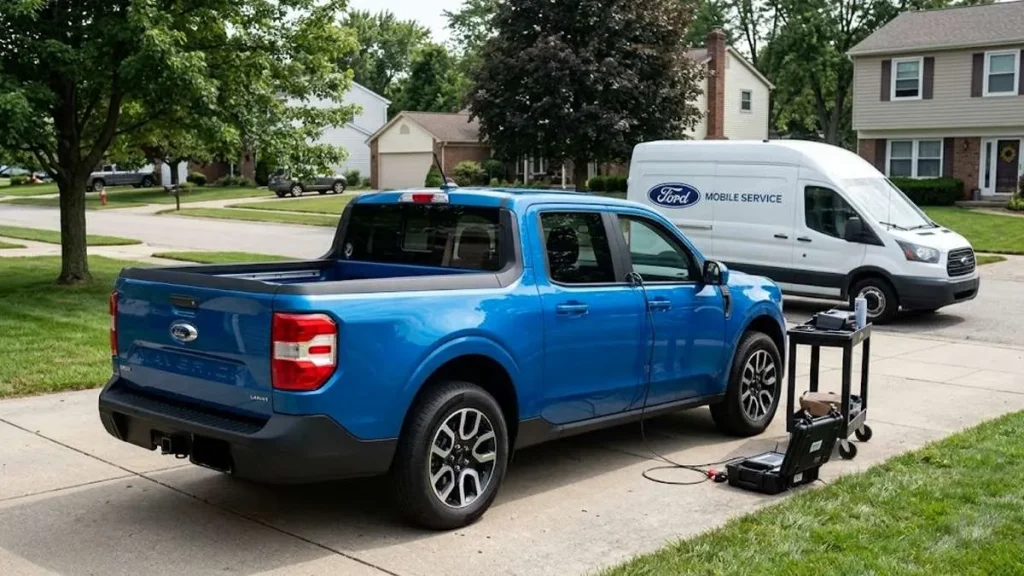
A 2024 Ford Maverick Lariat owner thought taking advantage of Ford’s mobile service for safety recall 26C10 would save a trip to the dealer. Instead, he said a digital tracking glitch left his truck stuck in recall limbo after the repair was finished. The fix is working, as Ford’s software patch for Recall 26C10 is active and successfully fixes the trailer brake and lighting drop-out bug. However, mobile techs can flash your truck at home, but weak cellular connections can prevent Ford’s database from marking the recall complete. Additionally, 2022–2024 Mavericks cannot get this safety patch over-the-air; they require a physical diagnostic cable plug-in. Ford’s promise of mobile driveway service is meant to take the hassle out of safety recalls. Instead of dropping off your truck at a dealership lot and losing half a day in a customer waiting lounge, a factory-trained technician comes directly to your home. For one 2024 Ford Maverick Lariat owner, scheduling Ford’s mobile unit to clear compliance recall 26C10, tracked as NHTSA Campaign 26V104, felt like modern truck ownership at its finest. The recall, which impacts roughly 412,000 Mavericks nationwide, addresses a safety-critical timing glitch in the Integrated Trailer Module. He claims the technician arrived, plugged in diagnostic tools, and successfully flashed the new software right on the driveway. But when the tech attempted to close out the job, the experience took a frustrating turn into software limbo: the physical repair on the truck was finished, but Ford’s corporate tracking servers refused to register the recall as complete. According to the owner, the driveway visit was arranged to avoid taking time out of his day. The technician hooked up a Ford VCM III diagnostic interface to the OBD-II port and successfully applied the updated calibration file using the Ford Diagnostic and Repair System. The patch was designed to eliminate a startup communication timing glitch between the Integrated Trailer Module and the Body Control Module. Without the patch, the glitch can throw a Trailer Brake Module Fault or Blind Spot Assist Unavailable alert on the dash. While the Maverick’s own lights function normally, connected trailer brake lights, turn indicators, and electric trailer brakes disengage completely. However, when the technician attempted to officially close out the safety campaign in Ford’s central database, the system hit a wall. The owner said the recall remained flagged as active on the vehicle record, leaving the dealership unable to mark the safety ticket complete despite having physically serviced the truck. Yes, Ford has released the official software patch to resolve the safety defect. However, early in the rollout, dealers faced hurdles getting the update to stick on 2022–2024 model years, even as 2025 and 2026 trucks were being updated. As forum participant MavStangVa noted, for a while even their dealer could not do the 24 Lariat even though 25 and 26 vehicles were getting the patch, and Ford finally figured out how to do the earlier models. While the calibration file is now fully working, the administrative close-out process remains the primary snag for driveway service calls. This owner’s experience sparked a wider community discussion regarding how Ford handles Electronic Control Unit module updates and warranty validation across different model years. For 2022 to 2024 models with Sync 3, the process requires a physical Ford Diagnostic and Repair System cable flash via a dealer bay or mobile tech. For 2025 and 2026 models with Sync 4, the vehicle supports full Electronic Control Unit module updates over the air or via the diagnostic system. As another forum member clarified regarding model year capability, model years 2022 through 2024 with Sync 3 audio can get over-the-air updates only for the audio system and navigation updates, and only model year 2025 and later can get over-the-air vehicle system updates or patches like the towing recall fix. Owners of 2022 through 2024 Mavericks run Ford’s legacy electrical architecture, which requires module-level recalibrations to be flashed manually using a wired connection. Unlike media or screen updates, critical safety modules like the trailer controller cannot update over the air on these earlier model years. Furthermore, when mobile technicians perform flashes in customer driveways using cellular hotspots, network latency or packet drops during the final validation handshake can prevent Ford’s central server from registering that the flash succeeded. The truck gets the updated software, but the corporate database still flags the Vehicle Identification Number as non-compliant. Before booking service, Maverick owners should verify the ticket with their service advisor to ensure it was successfully marked complete in Ford’s central system before the technician leaves. If the dash pops a false Trailer Brake Module Fault message before getting to the dealer, users can try the 15-minute reset by shutting off the ignition, locking the doors, and letting the truck rest for 15 minutes to allow the high-speed Controller Area Network bus to enter deep sleep and reset the boot-up sequence. Owners should also request printed documentation, such as a hard copy or digital receipt of the closed Repair Order showing the cleared campaign code to protect vehicle resale value and warranty history. The owner’s claim highlights a larger structural challenge facing the auto industry as vehicles become increasingly dependent on interconnected digital architecture, with mobile service programs relying heavily on seamless wireless execution behind the scenes.
📱 Follow our Telegram channel for daily updates
Source: Torque News